move-or-remodel
For Homeowners: $60,000 Remodel vs Moving When You Have a Low Mortgage
Most homeowners should renovate when their location works and the problems are fixable, and should move when location or structural limits block the change they want. The dominant variable is whether you’re solving a layout problem or a location problem. The 2025 Remodeling Impact Report and Consumer Financial Protection Bureau budgeting steps both point toward the same math. The checklist and worked examples below show you how to run it.
TL;DR:
Moving becomes more costly if a low mortgage rate is locked in, often outweighing renovation expenses once financing differences are considered.
Homeowners should account for all costs, including agent fees, moving logistics, and new mortgage rates, when comparing move versus renovation strategies.
Major structural issues or location constraints, such as foundation limitations or neighborhood drawbacks, typically make moving the smarter option.
A clear budget plan and detailed financial comparison are essential, converting total costs into monthly payments to decide the most affordable option.
Renovations that support structural changes or add significant space usually come close to the cost of trading up, reducing the benefit of moving in those cases.
SolutionteamremodelingPlan A Remodel That Fits Your HomeSolution Team Remodeling helps Redmond homeowners address outdated designs and inefficient layouts through thoughtful planning and skilled craftsmanship.Visit Solution Team Remodeling
Table of Contents
Run this checklist before you decide
Compare the full cost of moving against renovating
Line up your financing before you commit
Weigh the disruption against the dollars
See which upgrades actually pay you back
Know when moving is the only real answer
Work through the decision with your own numbers
What a remodeling pro actually looks for
How we can help if you decide to renovate
FAQ
Sources
Run this checklist before you decide
Before you call a single contractor or realtor, gather a short list of facts. This filters out the emotional noise and gets you to a real answer faster.
Ask yourself these yes or no questions first:
Do you genuinely love the location, or are you tolerating it?
Can the layout you want actually be achieved within your lot and structure?
Would you keep your current mortgage rate by staying, or lose it by moving?
Would the finished renovation push your home’s value above what neighbors are selling for?
Then collect these numbers before talking to anyone: your current mortgage rate, your estimated home equity, three contractor quotes for the project you have in mind, and a realistic expected sale price if you listed today.
Use these thresholds to sort the project by size: a small cosmetic update, a moderate kitchen or bath remodel, or a major structural or whole-home job. Budget a contingency of 10% to 15% on top of any renovation bid, and factor in closing costs of 2% to 5% if you’re pricing out a move.
Compare the full cost of moving against renovating
Comparing these two paths only works when you count every line item on both sides, not just the headline number.
Moving costs typically include, as explained in detail in the San Diego Home Selling Process:
Agent commissions and closing costs, often 2% to 5% of the sale price
Moving logistics: movers, storage, and temporary housing if timing overlaps
Immediate fixes at the new place, which almost every buyer underestimates
A new mortgage at today’s rate, which may be well above your current one
Renovation costs typically include:
The contractor’s bid for labor and materials
Permit fees, which vary by project scope and municipality
A contingency of 10% to 15% for the inevitable surprise behind the wall
Temporary relocation if the kitchen or only bathroom is out of service
A below-market mortgage rate can make moving far more expensive than it looks on paper. Advisors note that owners who locked in low rates between 2020 and 2022 often find that moving means trading that rate for a much higher one, which can add hundreds to a monthly payment regardless of the new home’s price.
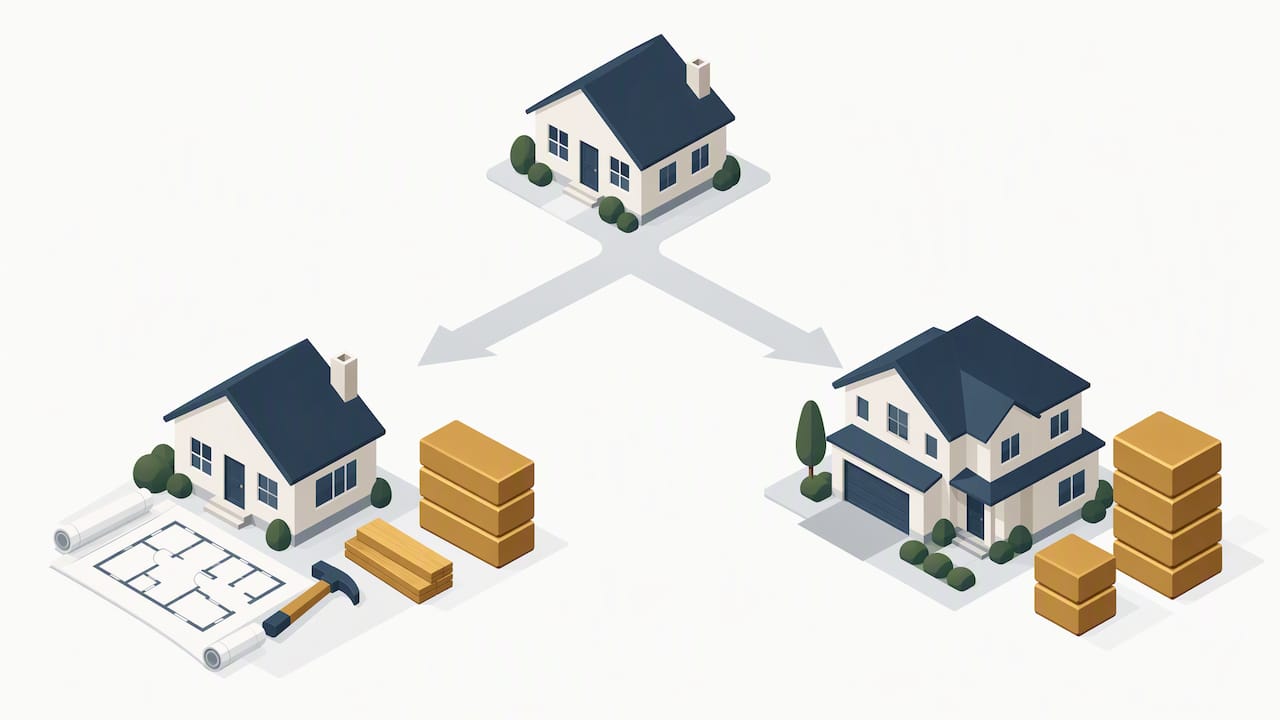
To compare fairly, convert one-time costs into a monthly equivalent using your likely loan terms, then stack that against a renovation loan’s monthly payment. A $60,000 kitchen remodel financed over 10 years lands in a very different monthly range than refinancing into a new house at a materially higher rate. Run both scenarios side by side before you commit to either path.
Line up your financing before you commit
How you pay for a renovation changes the math as much as the renovation itself.
A HELOC gives you flexible, draw-as-needed access but usually carries a variable rate.
A home equity loan offers a fixed rate and payment, useful for a single defined project.
A cash-out refinance can fund a larger remodel but resets your entire mortgage at today’s rate.
A personal loan avoids touching your mortgage but typically costs more in interest.
Paying from savings avoids debt entirely but ties up your cash reserves.
The CFPB’s budgeting method is a useful starting point: total your savings and investments, subtract money earmarked for other goals, then subtract expected closing costs before you decide what’s actually available to spend. If you’re sitting on a mortgage rate well below current market rates, think hard before refinancing into a bigger loan just to fund a remodel, since that resets your whole balance at the higher rate.
Pro Tip: Phase a large renovation into stages (kitchen this year, bathrooms next) to avoid one massive loan and give yourself room to adjust the budget as you go.
Weigh the disruption against the dollars
Money is only half the decision. Living through a renovation, or living through a move, both cost you time and sanity in different ways.
A paint or flooring refresh usually disrupts daily life for a few days to a week.
A full kitchen or bathroom remodel often takes several weeks and makes that room unusable.
A room addition or structural project can stretch for months and affect multiple areas of the house.
You can reduce the pain with a few practical moves: phase the work so only one zone is offline at a time, rent short-term housing during the roughest stretch, seal off work areas with temporary barriers, or hire a design-build contractor who manages the whole process under one roof instead of juggling separate trades yourself.
If you work from home, have pets, or have kids in a school routine, factor that disruption into your decision the same way you’d factor in a cost line. A move disrupts all of it at once, briefly. A remodel disrupts it in smaller doses, for longer.
See which upgrades actually pay you back
Not every renovation dollar comes back to you at resale, and the data on this is specific enough to plan around.
A steel front door replacement recovers nearly all of its cost at resale. Closet renovations, window replacements, and room conversions also yield strong recovery. Kitchen and bathroom remodels tend to have lower pure dollar recovery but score high on homeowner satisfaction.
The 2025 Remodeling Impact Report also tracks a “Joy Score,” a satisfaction measure separate from resale math, and for owners planning to stay put for years, that score often matters more than the recovery percentage.
If you’re not selling soon, weigh projects by how much they improve your daily life, not just your eventual sale price. The one guardrail: avoid pushing your home’s value so far past what neighbors are selling for that you can’t recoup it, a pattern often called over-improving for the neighborhood.
Know when moving is the only real answer
Some problems simply cannot be renovated away, and recognizing them early saves you money and frustration.
School zones, commute distance, and neighborhood amenities are fixed by address, not by floor plan.
A lot too small for the addition you want, or a foundation that can’t support a second story, can make your desired change structurally impossible or disproportionately expensive.
If a contractor’s estimate for the changes you want approaches or exceeds what a comparable move would cost once you include financing differences, moving is usually the smarter call.
If your dissatisfaction is really about the neighborhood, a remodel is a cosmetic fix for a location problem, and it won’t hold up over time.
Work through the decision with your own numbers
A repeatable process beats a gut call, and it only takes three steps.
Gather your data: current mortgage rate, home equity, a real contractor estimate, and expected net proceeds from a sale.
Run the apples-to-apples comparison: total every cost on both sides, then convert each total into a monthly-equivalent payment using realistic loan terms.
Apply your non-financial filters: location, school access, commute, and how long you plan to stay, then pick the path that wins on both fronts.
Financed over 7 years, that’s a modest monthly add-on. Moving would mean a new mortgage likely several points higher. The remodel wins easily.
Large project example: A family wants a two-story addition quoted at $220,000, close to the cost of trading up to a larger home in the same school district. Here the comparison tightens. If the current mortgage rate is only slightly below market, moving may come out ahead once you account for getting the space without years of construction.
Run your own numbers through these same three steps before you sign anything.
What a remodeling pro actually looks for
When we scope a job, we’re checking whether the structure can support what you’re imagining before we ever talk finishes. Early planning, including a pre-demo look at electrical, HVAC, and foundation condition, prevents the budget blowouts that push people toward regret. The clearest red flag pointing toward moving instead: a lot or foundation that can’t support the change at any reasonable price.
We build our process around transparent communication, thoughtful planning, and honest pricing with no pressure.
— Vlad
How we can help if you decide to renovate
If your numbers point to staying and fixing, we offer remodeling services including kitchen, bathroom, interior, and whole-home remodeling, along with flooring, trim, and installation work. We build every project on thoughtful planning and clean craftsmanship, so you get a clear scope and an honest number before any work starts.

A free consultation with our team includes a scope check against your goals, a rough budget range, and a clear next step, whether that means moving forward with a plan or confirming that renovating is the right call for your situation.
Get a free estimate to start the scope and budget conversation.
Browse our kitchen, bathroom, and whole-home services to see what’s included.
FAQ
What is the 30% rule in remodeling?
It’s a guideline, not a hard cap, and it matters most if you plan to sell within a few years.
What devalues a house the most?
Deferred maintenance, outdated systems like old electrical or plumbing, and renovations that clash with the style or price point of the surrounding neighborhood tend to hurt value the most. Over-improving past what nearby homes support can also limit how much you recover.
Is $50,000 enough to remodel a house?
It depends heavily on scope: a kitchen or bathroom remodel can range from moderate to major in scale, but a whole-home renovation or structural addition usually costs much more. Get contractor quotes specific to your project before assuming a budget will cover it.
What does Dave Ramsey say about home renovations?
The general advice repeated in personal finance circles is to avoid going into debt for renovations and to pay cash when possible, prioritizing projects that improve safety or function over purely cosmetic upgrades. The CFPB’s budgeting approach offers a similar cash-first method for figuring out what you can actually afford.
Sources
Figure out how much you want to spend | Consumer Financial Protection Bureau
How to decide if you should renovate your home or move | The Week
Recommended
Back to Blog
