bathroom-remodel-roi
$5,000–$50,000: How Homeowners Protect Bathroom Remodel ROI
A midrange bathroom remodel typically recoups a solid share of its cost at resale, while a minor refresh often returns more per dollar and an upscale overhaul tends to recover the least as a percentage of spend. The number that matters most for your project is not the national average. It is your local market and whether your finishes match what buyers in your price range expect.
TL;DR:
A $60,000 spa bathroom in a $400,000 home risks overimprovement; the same budget would likely perform better across three midrange bathrooms.
A $5,000 budget usually covers cosmetic updates, while about $10,000 can replace a vanity, toilet, flooring, and fixtures without moving plumbing.
Around $25,000 typically covers a full midrange remodel, while $50,000 may add custom finishes or layout changes that lower percentage recovery.
Keeping plumbing in place protects the budget because relocations, permits, and hidden water damage can add costs without creating visible buyer appeal.
Add a bathroom only when comparable homes offer more bathrooms than yours; otherwise, targeted updates to flooring, lighting, storage, and fixtures are safer bets.
SolutionteamremodelingPlan a Bathroom Remodel That FitsSolution Team Remodeling helps Redmond homeowners update bathrooms with thoughtful planning, skilled craftsmanship, and an organized remodeling process.Explore remodeling services
Table of Contents
1. What industry data says about ROI by remodel level
2. What changes your ROI: condition, scope, timing, and demand
3. What $5,000, $10,000, $25,000, and $50,000 typically buy
4. Which upgrades actually pay you back at resale
5. Budgeting, timeline, and contractor choices that affect your return
6. A step-by-step checklist to protect your resale value
7. How professional planning protects your ROI
8. Resale value versus the joy of living in your remodeled bathroom
How we help homeowners get both value and livability
FAQ
Sources
1. What industry data says about ROI by remodel level
Cost recovery for a bathroom project depends heavily on how much you spend and where that money goes. The 2025 Remodeling Impact Report from the National Association of the Remodeling Industry (NARI) tracks cost-recovery estimates alongside homeowner satisfaction, and its figures line up with what Zillow’s ROI guidance on bathroom remodels has long reported using data from the Journal of Light Construction (JLC): midrange projects consistently outperform upscale ones on a percentage basis.
A few patterns show up across these reports:
Minor bathroom refreshes (new fixtures, paint, updated lighting) tend to recover a large share of cost because the spend is small and the visual impact is high.
Midrange full remodels (new vanity, tile floor, standard-grade fixtures) recover a strong percentage, often cited as the most efficient tier for resale.
Upscale remodels (custom cabinetry, high-end stone, specialty fixtures) usually recover a smaller percentage, even though the finished space looks more impressive.
Regional variance is real: labor costs, material pricing and local buyer expectations all shift these numbers up or down depending on where you live.
NARI’s 2025 data shows bathroom renovations generate strong homeowner satisfaction alongside measurable cost-recovery estimates, reinforcing that midrange work tends to strike the best balance between spend and return.
2. What changes your ROI: condition, scope, timing, and demand
Your bathroom’s starting condition and your home’s overall price point set the ceiling for what a remodel can recover. A gut renovation in a modest, mid-priced neighborhood risks over-improvement: you spend upscale money in a market that will not support an upscale resale price, and the gap between cost and value widens.
Quality level matters more than most homeowners expect. Midrange finishes often outperform upscale ones in recoup percentage because buyers compare your home to others in the same price bracket, not to luxury listings. A $60,000 spa bathroom in a $400,000 house rarely returns what it cost, while the same money spent on three midrange bathrooms would likely perform better across the whole sale.
Timing also plays a role. Buyers actively look for updated bathrooms, and a dated or worn bathroom can slow a sale even when the rest of the home is in good shape.
Over-improvement risk: spending above what comparable homes in your area support.
Quality mismatch: luxury finishes in a starter or midrange home.
Timing gap: remodeling too far ahead of a sale, where trends or wear can erode the benefit.
Pro Tip: Talk to a local Realtor® before you finalize scope. They can tell you what buyers in your specific market actually pay more for.
3. What $5,000, $10,000, $25,000, and $50,000 typically buy
Budget determines scope, and scope determines how much of that money comes back at resale. Here is roughly what each range covers and the kind of outcome it tends to produce.
Around $5,000: a cosmetic refresh, think new paint, updated lighting, a new mirror and faucet, maybe a reglazed tub. Small spend, often a strong percentage recovered because the project barely touches labor-intensive work.
Around $10,000: a partial remodel, such as a new vanity, toilet, flooring and fixtures, without moving plumbing. Still efficient, and a common sweet spot for sellers prepping a home.
Around $25,000: a full midrange remodel, new tile, standard-grade fixtures, solid-surface counters, updated ventilation. This tier is where NARI and Zillow/JLC data consistently show the strongest balance of cost and recovered value.
Around $50,000: an upscale remodel with custom cabinetry, premium stone, high-end fixtures or a layout change. Impressive result, but recoup as a percentage typically drops compared to midrange work.
Hidden costs can quietly push any of these budgets higher. Moving plumbing lines, discovering water damage behind old tile, or needing a permit you did not plan for are the most common surprises, and our guide to small bathroom remodel costs walks through how plumbing relocation specifically drives up small-project budgets.
4. Which upgrades actually pay you back at resale
Not every dollar spent in a bathroom returns the same value. The upgrades that consistently perform well are the ones buyers notice immediately and the ones that fix a visible problem.
New vanity and modern fixtures: high visual impact for moderate cost.
Updated tile flooring: buyers associate old flooring with an outdated bathroom, so this upgrade reads as a full refresh even on a partial budget.
Improved lighting and ventilation: functional upgrades that buyers feel immediately, even if they cannot name why the room feels better.
Fresh, neutral paint: one of the cheapest ways to make a bathroom look finished.
Added storage: buyers consistently value usable storage over decorative flourishes.
Adding an entire bathroom can be worth more than remodeling an existing one, but only in homes where bathroom count is genuinely below what comparable listings offer. In a home that already has enough bathrooms for its size, that spend rarely pays off the way a well-targeted remodel does.
5. Budgeting, timeline, and contractor choices that affect your return
How you manage the project matters almost as much as what you choose to install. Permits are the first thing to plan for: our breakdown of bathroom remodel permit triggers and costs covers when a permit is required and what it typically adds in cost and time.
Plumbing and electrical relocations are the biggest budget inflators, and they also reduce your odds of a strong recoup, since that money goes into infrastructure buyers never see. Keeping fixtures in their existing locations is one of the simplest ways to protect your budget.
Typical timelines run from a couple of weeks for a cosmetic refresh to several weeks for a full remodel involving permits, and our bathroom remodel timeline guide lays out two realistic schedules depending on scope.
Ask for a detailed, itemized bid, not a lump sum, so you can see where the money goes.
Confirm who pulls permits and whether that cost is included in the quote.
Clarify the payment schedule tied to project milestones, not just time elapsed.
Pro Tip: A fair contractor margin is built into a transparent, itemized bid, if a quote feels vague, ask for specifics before signing.
6. A step-by-step checklist to protect your resale value
A simple sequence of decisions keeps a bathroom remodel aligned with what it can realistically return.
Match scope to your home’s price bracket before picking finishes, not after.
Choose midrange materials like ceramic tile, solid-surface counters and standard-size vanities, since JLC and Zillow data tie these choices to the strongest recoup.
Keep plumbing and drain locations wherever the layout allows, to avoid the biggest cost driver.
Document every upgrade, keep receipts and warranty paperwork, since appraisers and buyers both respond to a clear improvement record.
Loop in a Realtor® and a trusted contractor before committing to major spend, especially if a sale is on the horizon.
NARI’s 2025 Remodeling Impact Report ties bathroom renovations to some of the strongest homeowner satisfaction scores in its survey data, a reminder that recoup percentage is only part of the value a remodel delivers.
7. How professional planning protects your ROI
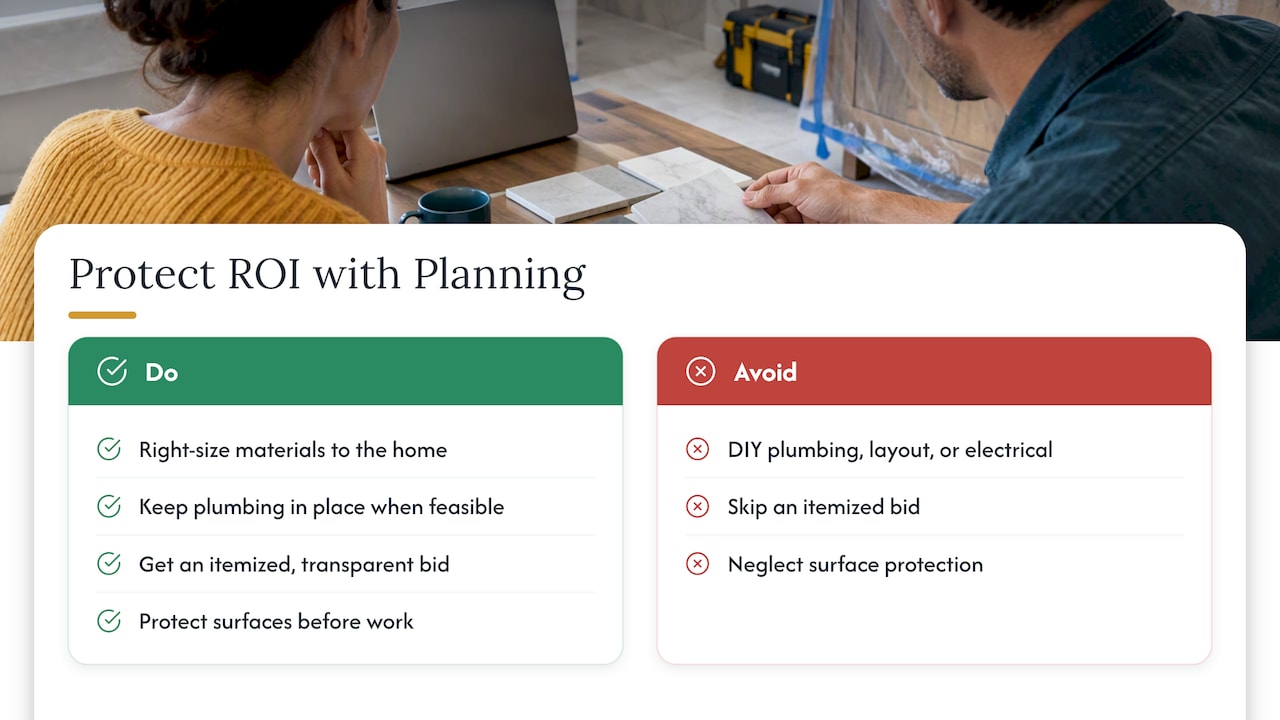
Organized planning is what separates a remodel that protects its value from one that quietly bleeds budget. Right-sizing materials to the home, keeping plumbing in place where feasible and getting a transparent, itemized bid before work starts all reduce the chance of mid-project surprises that eat into recoup.
A good rule of thumb: hire a professional when the project involves plumbing relocation, layout changes or electrical work, and consider DIY only for cosmetic tasks like painting or fixture swaps. Before any interior work begins, it is worth protecting surfaces properly, and this guide to preparing a home for drywall and painting work covers the basics of avoiding collateral damage during a remodel.
8. Resale value versus the joy of living in your remodeled bathroom
Chasing the highest recoup percentage can lead you to a bathroom that performs well on paper but feels sterile every morning. NARI and NAR data consistently show homeowner satisfaction, often called a Joy Score, outpacing strict financial return on these projects. My take: let resale data set your budget ceiling, then spend inside it on the choices that make the room genuinely yours to live in.
— Vlad
How we help homeowners get both value and livability
Bathroom remodels should be built around the principle of matching the scope to the home, choosing materials that hold their value, and keeping every detail organized so nothing derails the budget midstream. Each project should be planned with clear material guidance and honest, transparent pricing, so you know what you are paying for before work begins, and scheduling should be reliable so your timeline holds.
Thoughtful planning that matches your remodel to your home’s price point and your goals for living in it.
Transparent, itemized pricing with no pressure to upsize your scope.
Reliable scheduling and meticulous execution from qualified professionals.
If you are weighing a bathroom remodel, you can request a free estimate to help map a scope that protects your budget and your return.
FAQ
What is the 30% rule for renovations?
It is a rule of thumb, not a fixed formula, and local buyer expectations matter more than the exact percentage.
Is $10,000 enough to remodel a bathroom?
Around $10,000 typically covers a partial remodel, such as a new vanity, toilet, flooring and fixtures, without relocating plumbing. It will not stretch to a full gut renovation, but it is a common, efficient budget for sellers prepping a home before listing.
How much profit should a contractor make from a bathroom remodel?
Fair contractor margins vary by region and project complexity, and they should be visible in a detailed, itemized bid rather than hidden in a lump sum. Asking for that level of detail is the simplest way to confirm the pricing is reasonable.
Is $5,000 enough to remodel a bathroom?
Around $5,000 generally covers a cosmetic refresh, new paint, lighting, a mirror, faucet and possibly a reglazed tub, rather than a full remodel. It can still meaningfully improve how a bathroom shows to buyers, especially in an otherwise well-maintained home.
Recommended
Back to Blog
